
Worth County Arrest Court Records
Worth County criminal cases are handled in Iowa District Court, Judicial District 2. The local court page and the Iowa Judicial Branch identify the Clerk of Court at 1000 Central Ave., Northwood, IA 50459, phone 641-324-6539. That office is the local court-record custodian for filed criminal cases, while Sheriff Jesse Luther and the Worth County Sheriff's Office run the jail and the public custody roster at 1000 Central Ave., phone 641-324-2481, fax 641-324-2611, with sheriff hours listed as 24/7. The two offices sit in the same courthouse and county-government complex, but they answer different record questions.
After a jail arrest, the early booking record may list a law-enforcement charge or hold reason. The formal court record follows when the Worth County Attorney files a complaint, trial information, indictment, or other charging paper. Iowa uses county attorneys, not district attorneys. Worth County lists County Attorney Jeffrey Greve at Greve Law Office, 736 Central Ave., Northwood, IA 50459, phone 641-324-1291. Iowa Code section 331.756 gives county attorneys the duty to prosecute state criminal laws, prosecute specified misdemeanors, prepare indictments and informations, and enforce forfeited bonds.
A booking record is useful for immediate custody questions, but it is not the same as the filed case. Current jail custody and booking status belong with Worth County jail inmate records. Booking photos and mugshot access are a separate topic on the Worth County jail mugshots page. Court records after a jail arrest focus on charges, case IDs, hearings, bond entries, dispositions, and court costs.
Find Worth County Court Records
The statewide public portal is Iowa Courts Online. It lets public users search trial court records and open case ID links for available details. The official Iowa Courts Online guide says search results are not the official court record and errors should be reported to the district court clerk. That matters in Worth County because a stale search result, a name mismatch, or a missing older case should be checked with the Clerk of Court before a decision is made from the screen result alone.
The county court page also points users back to the Iowa Judicial Branch for complete and current district court information. For in-person help, Worth County's court page says jurors check in at the Clerk of Court office and park in the courthouse parking lot. Court security is handled by the sheriff at 641-324-2481. The same sheriff phone also appears on the county hours page as a 24/7 contact, but the clerk phone is the direct local number for filed court records.
The official Iowa Judicial Branch Worth County page identifies the local court office for Worth County case access. The county's own courts page gives local parking, court security, and jury check-in context.
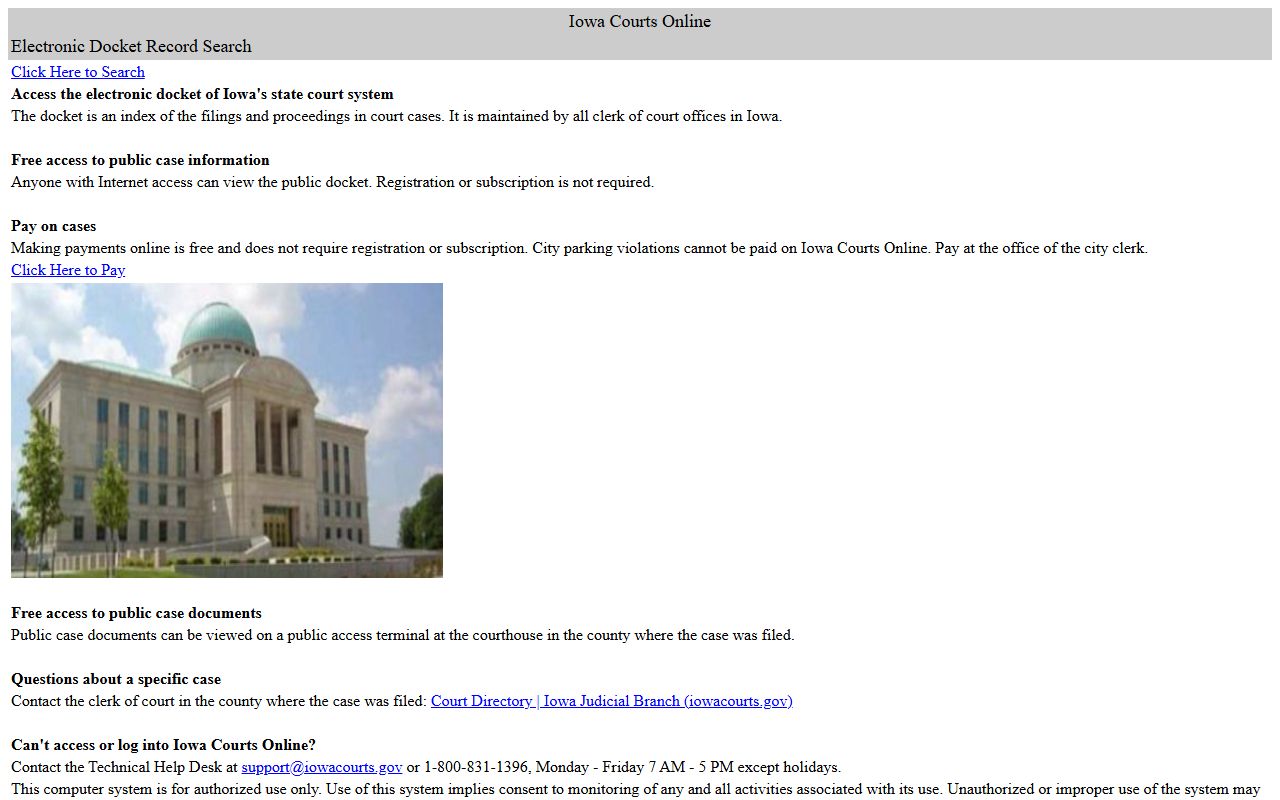
Iowa Courts Online is the starting point for filed charges, but the clerk remains the official source when a public search is incomplete, restricted, or hard to match to the right person.
Worth County Case Search Fields
Court records after a Worth County arrest are easiest to find when the search starts with the same name spelling used in jail paperwork or a citation. The Iowa Courts Online guide says the last or firm name search needs at least two letters, and a case ID search needs the county and case type. Criminal case IDs may use short codes that do not look plain to a first-time user. FE is felony, AG is aggravated misdemeanor, SR is serious misdemeanor, SM is simple misdemeanor, OW is operating while intoxicated, and CR is criminal.
| Field | Required | Worth County Use |
|---|---|---|
| Last/Firm name | Yes for name search | Use at least two letters; spell the name as shown in court or jail papers. |
| First name | Optional | Narrows common-name results; initials are entered without a period. |
| Date of birth | Yes for DOB search | Useful when multiple defendants share a similar name. |
| County | Yes for case ID search | Select Worth for Worth County cases in Judicial District 2. |
| Case type | Yes for case ID search | Criminal examples include FE, AG, SR, SM, OW, NT, ST, and CR. |
| Case ID | Optional with county/type | Use the 17-character case ID when known; capital letters matter. |
| Citation number | Yes for citation search | Best for traffic or citation-led cases after an arrest or summons. |
When a result opens, look for the defendant name, case type, created date, charge, count, description, disposition, filed date, status, fine amount, costs, bail set amount, posted amount, posted date, poster, agent, and bond type where those fields appear. Some links and advanced details are limited to a clerk's public terminal or paid subscription, so an online search may show enough to identify the case without showing every supporting detail.
Search After Worth County Arrest
The arrest to court path usually runs from booking to first appearance to filed charges. The jail roster may help confirm the name and arrest window, but the court portal is where filed charges, hearing activity, and dispositions should be checked. If the person was arrested on a warrant, Iowa Code section 804.21 requires prompt appearance before an accessible magistrate. Iowa Code section 804.22 applies similar prompt-appearance language after a warrantless arrest.
- Start with the jail or arrest paperwork to confirm the exact name, rough booking date, and possible charge wording.
- Open Iowa Courts Online and search by name, DOB, citation number, or case ID if known.
- Filter the result to Worth County or confirm the case belongs to Judicial District 2.
- Open the case ID and review the Criminal Charges/Dispositions section for charge, count, filed date, status, and disposition.
- Check the Bonds section when release terms or posted bond are the main issue.
- Call the Clerk of Court at 641-324-6539 if the case is older, restricted, unclear, or not visible online.
A criminal-history check is a different product. The Iowa DPS Division of Criminal Investigation accepts requests online, by mail, fax, email, or in person, but it does not accept phone requests. DCI checks cost $15 per last name. A request must include at least first name, last name, and exact date of birth, while gender, Social Security number, and middle name can help with common names.
Worth County Charging Documents
The court record starts because a charging document tells the court what offense is alleged and who is being charged. A jail arrest may occur first, but the prosecutor controls the formal charge path. In Worth County, the County Attorney prosecutes violations of state criminal laws and county ordinances, including misdemeanors and indictable offenses assigned by Iowa law. The filed charge can match the booking charge, but it can also be changed, narrowed, expanded, or dismissed as the case develops.
| Document | Filed By | Common Use | What to Check |
|---|---|---|---|
| Complaint | Officer or prosecutor | Often starts a criminal case or supports an initial charge. | Charge description, probable-cause statement, defendant name, filed date. |
| Trial information | County Attorney | Common Iowa charging paper for indictable offenses after prosecutor review. | Counts, code sections, amendments, arraignment or plea deadlines. |
| Indictment | Grand jury | Used less often, but still a formal charge route for serious cases. | Count list, offense level, filing date, later amendments. |
The terms can be confusing because the roster may use a plain-language charge label while the court case may use an Iowa offense code, count number, or case type abbreviation. FE is more serious than SM. OW can signal an operating-while-intoxicated case. A charge entry is still an accusation unless a plea or verdict makes it a conviction.
Worth County Charge Status
Charge status changes are the main reason court records after a jail arrest should be checked more than once. A filed case can add counts, drop a count, amend the offense, set bond, post payment, continue a hearing, defer judgment, or close with a plea, trial verdict, dismissal, or other disposition. The most accurate status is the one in the current court case, not a screenshot of an early booking entry.
| Status | Meaning | Why It Matters |
|---|---|---|
| Pending | The charge remains active and has not reached final disposition. | Hearings, bond terms, and no-contact orders may still change. |
| Amended | The charge wording, level, or code changed after filing. | The final court charge may differ from the jail booking charge. |
| Reduced | The charge was lowered to a lesser offense. | The case may still end in conviction, but not for the original level. |
| Dismissed | The count ended without conviction on that charge. | Other counts in the same case may still remain. |
| Disposition | The current or final outcome entry for a charge or case component. | Read each count separately because one case can have mixed results. |
| Deferred judgment | An Iowa outcome that may be treated differently from a standard conviction. | DCI release limits and later expungement analysis may differ. |
Bond and Worth County Warrants
Bond can appear in both custody and court workflows. Worth County's sheriff FAQ says to verify the bond amount by calling the jail at 641-324-2481 before posting cash bond. During regular business hours, cash bond is brought to the Worth County Sheriff's Office and presented to the clerk or jailer. After hours, the correct cash amount can still be brought directly to the Sheriff's Office. The FAQ also says bonding agencies are separate from the sheriff and are not recommended or discredited by the office.
Iowa Code section 811.1 gives the broad right to bail before and after conviction, subject to exceptions. Iowa Code section 811.2 allows recognizance or unsecured appearance bond unless the magistrate finds appearance or safety concerns, and it also permits conditions such as supervision, travel limits, contact limits, cash deposit, or surety bond. A no-bond hold or detainer can block release even when a local cash amount appears in one record.
| Bond or Hold | How It Works |
|---|---|
| Cash bond | Cash posted directly after the jail confirms the exact current amount. |
| Cash/surety | Bond backed by cash or a surety arrangement. |
| Recognizance | Release based on a promise to appear, often with court conditions. |
| No-bond hold | Release is blocked by a warrant, other agency hold, court order, or serious case status. |
Worth County does not publish an official active warrant database. The practical channels are the sheriff at 641-324-2481, the Clerk of Court at 641-324-6539, and Iowa Courts Online for related case entries. Iowa DPS operates the IOWA System for warrants and criminal-justice records, but that system is for law-enforcement and criminal-justice agencies, not public warrant searching.
Charges Versus Convictions
A Worth County arrest, a filed charge, and a conviction are three different record points. A person can be arrested and never charged. A person can be charged and later have a count dismissed. A person can plead guilty to one count while another count is dropped. Court records after a jail arrest should be read count by count, not as one flat label.
| Point | Charge | Conviction |
|---|---|---|
| Meaning | An accusation filed or listed by law enforcement or the prosecutor. | A guilty plea, guilty verdict, or other adjudicated guilty result. |
| Proof stage | Based on probable cause or prosecutor filing review. | Requires plea or proof beyond a reasonable doubt. |
| Where it appears | Jail roster, complaint, trial information, or court charge list. | Disposition, judgment, sentence, or criminal-history result. |
| Risk of mismatch | Can be amended, reduced, or dismissed. | Should be tied to a final court disposition for the exact count. |
Sealed and Expunged Records
Iowa public-records law starts with access to public records, but Iowa Code section 22.7 lists confidential categories. Juvenile records, sealed records, sensitive personal information, and peace-officer investigative reports can be restricted. Iowa Code section 22.7 also treats some criminal identification files as confidential while recognizing access to records of current and prior arrests and criminal-history data in the cited law-enforcement subsections. That mix explains why one Worth County arrest can produce some public entries and some withheld material.
| Issue | Sealed | Expunged |
|---|---|---|
| Public visibility | Hidden or restricted from public view by court order or law. | Removed or treated under the specific expungement order or statute. |
| Record holder | The court or agency may still retain a limited-access record. | The effect depends on the Iowa provision and the order entered. |
| Common trigger | Juvenile matter, protected case type, sealed filing, or safety concern. | Eligible dismissal, deferred judgment issue, or other qualifying disposition. |
| Best office | Ask the Clerk of Court about court access limits. | Ask the court or an attorney about eligibility and order language. |
A dismissed charge is not always erased from every record source. DCI release rules are also narrower than a live court docket. Without a signed release, Iowa DPS says completed deferred judgments and arrests over 18 months old without final disposition cannot be released to non-law-enforcement agencies, and most juvenile information is confidential.
Restricted Worth County Records
Some court records after a jail arrest can be public in part and restricted in part. A docket may show a case ID and charge while an investigative report stays confidential. A bond entry may be visible while victim details or medical details are not. A juvenile matter may not appear like an adult criminal case. Iowa Code Chapter 22 and section 22.7 are the key access laws, but each custodian applies them to the record held by that office.
For filed court papers, start with the Clerk of Court. For booking sheets, jail logs, bond confirmation, or a sheriff arrest record, start with the Worth County Sheriff's Office. Ask for a specific existing record and include the person's full name, date of birth if known, arrest date or rough date, and court case number if available. If a record is denied or redacted, ask for the Iowa Code authority for withholding.
Important: Worth County Inmate Population is not a consumer reporting agency, and court or arrest data must not be used for FCRA-covered screening.